You may be holding a notice from a building official, a red tag on the front door, or a property you inherited that the city has already declared unfit to live in. At that point, owners typically face a decision. Money and months could go into repairs, the property could be sold as it stands, or the order itself might be challenged. That choice gets made while the property sits empty and the enforcement file stays open. This page explains what a condemnation order means, how a California owner can respond, and how correcting the conditions compares with selling in present condition, so the questions that matter for a particular property come into focus.
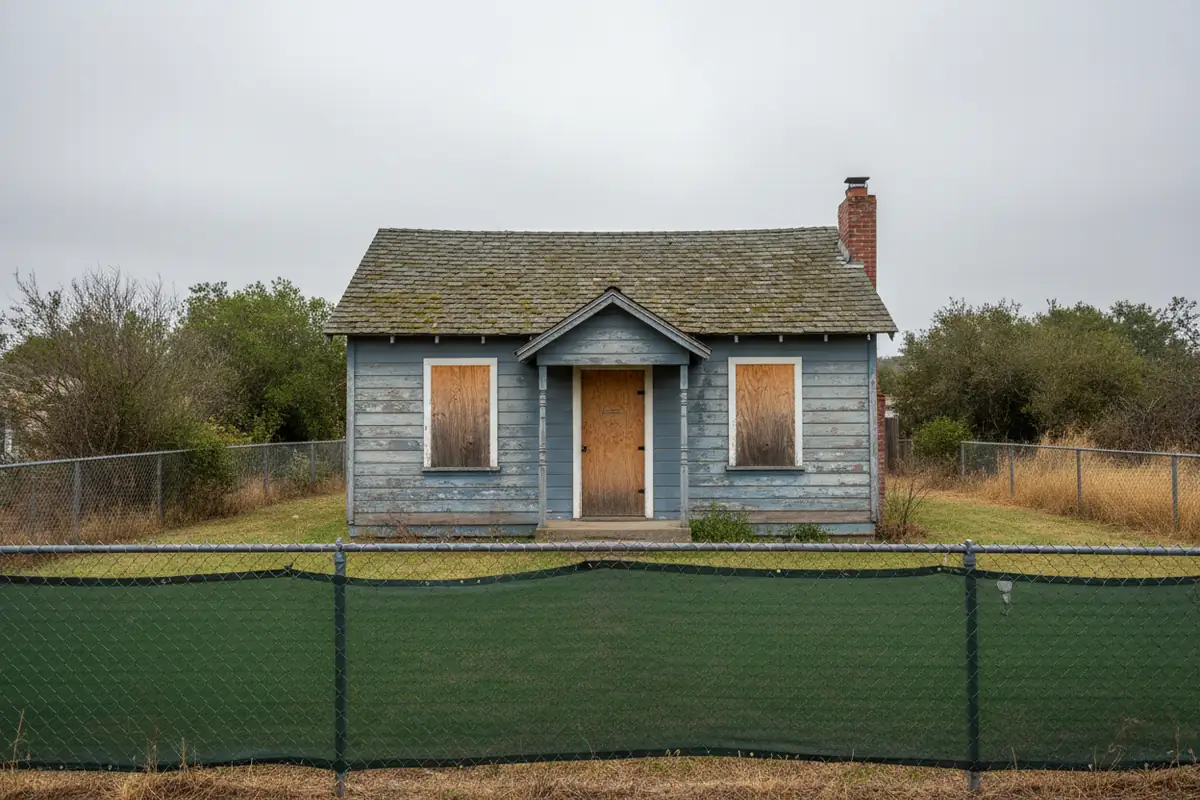
If your California house has been condemned, you can generally still sell it in its present condition. Selling does not lift the order. The condemnation order and any recorded liens stay with the property, the buyer takes it subject to them, and you still owe the buyer full disclosure of the order and of the conditions you know about.
On this page
- Key Takeaways
- What Qualifies a House as Condemned in California
- When Selling a Condemned Property Fits
- If the Property Is Occupied or the Order Is Disputed
- How It Works, Step by Step
- Costs, Timing, and Trade-offs
- Options to Compare
- What to Have Ready
- Local Context: California Enforcement and Disclosure Rules
- Frequently asked questions
Key Takeaways
A condemned property is one that a local government official has determined is unfit for people to occupy or use. In California, that kind of determination generally rests on authority in the California Health and Safety Code, which deals with substandard buildings, and on the local building and housing codes that cities and counties enforce.
A condemnation order is different from an ordinary code violation notice. A violation notice tells the owner to correct specific conditions and does not necessarily stop anyone from living in the building. A condemnation or unfit-for-occupancy order goes further: it prohibits occupancy until the conditions are corrected. Serious violations that go uncorrected can lead from the first kind of notice to the second.
Owners typically respond in one of three broad ways:
- Correct the conditions. The owner makes the repairs and asks the issuing agency to lift the order.
- Sell in present condition. The order and any liens pass to the buyer.
- Consult an attorney. This path applies where the owner believes the order is wrong or a dispute is involved.
Which path fits depends on the owner's resources, the property's condition, the liens on record and the owner's timeline.
What Qualifies a House as Condemned in California
The decision to condemn a building is made by a local building official or code enforcement officer, not by a court. A building official is the person at a city or county building department who enforces construction and safety codes. A code enforcement officer is the local employee who investigates and cites violations. Both apply standards that California law sets statewide, and the Health and Safety Code is the main state authority for substandard-building findings.
The conditions that commonly lead to a substandard or unfit-for-occupancy finding fall into broad categories:
- Structural hazards. Examples include failing supports, unstable walls or roofs, or damage that makes a collapse possible.
- Missing required utilities. Examples include no working water, heat, sanitation or safe electrical service.
- Fire and health hazards. Examples include dangerous wiring, blocked exits, contamination or conditions that harbor pests.
- Severe unpermitted alterations. This means work done without permits that creates a safety risk.
These categories describe the general picture rather than a complete legal list. The local code and the order itself say exactly which conditions were cited in a particular case.
A "red tag" is the visible sign of this kind of order: a notice posted on the building that prohibits occupancy. The details of red-tag notices and unsafe-structure findings are explained further in building code violations and substandard housing.
Condemnation in this sense is not foreclosure, which is a lender's process for collecting on a loan. Nor is it an eminent-domain taking, in which a government acquires private property for public use. Each of those is a separate legal process with its own rules.
When Selling a Condemned Property Fits
Selling in present condition tends to come up in a few situations:
- The owner lacks the money or the time to complete the repairs the order requires.
- Heirs inherit the property and do not want to manage a rehabilitation.
- The repair costs approach or exceed what the property would be worth once repaired.
- The owner faces further enforcement steps and does not want to carry the property through them.
The key point for a seller is that the condemnation order runs with the property. In plain terms, it is attached to the house, not to whoever owns it, so a new owner inherits it along with any recorded liens that are not paid off at closing.
That fact drives pricing. A cash buyer taking a condemned property as it is will usually set the price to cover the repairs still to be finished, the enforcement risk being inherited, and the cost of reselling later. The offer is often lower than an open-market price for a comparable house in good condition. In exchange, the seller does less preparation work and has fewer contingencies tied to a buyer's loan approval. A contingency is a condition in the contract that must be met before the sale goes through.
Disclosure is not something an as-is label changes. California law requires a seller to disclose known material facts that affect a property's value or desirability, and a condemnation order or notice of violation is that kind of fact. The California Transfer Disclosure Statement is the standard form a residential seller uses to describe known conditions. "As-is" describes the condition the buyer accepts; it does not remove any disclosure, lien or enforcement step.
If the Property Is Occupied or the Order Is Disputed
The sections above assume an empty property and an order the owner accepts. Two other situations change the picture, and each is a matter the issuing agency or an attorney addresses rather than something this page can resolve.
Tenants or other occupants. Because a condemnation order generally prohibits occupancy, anyone living in the building is affected by it. Where tenants are involved, questions about their move-out and any obligations the owner may have toward them fall outside a simple sale and are matters for the issuing agency or an attorney. This is also why occupancy status appears in the "What to Have Ready" list and in the questions a request through this site asks.
Disagreeing with the order. An owner who believes the order is wrong is in a different position from one weighing repair against sale. A contested condemnation is a legal matter, and the order itself and the issuing agency are where the owner would see what process applies. This page treats that path as one of the options, not as a step in a sale.
Insurance. Carrying a condemned property includes insurance cost for as long as the owner holds it. How an existing policy treats a vacant or condemned building is a question for the insurer.
How It Works, Step by Step
Selling a condemned or substandard property in California generally follows this order.
1. Read the order itself. Note which conditions are cited, which agency issued the order, and whether it mentions abatement costs or a lien. Abatement is the work an agency does to remove or reduce a hazard, such as boarding up or securing a building. The guide to reading a code enforcement notice explains what a notice typically contains.
2. Check what is recorded against the title. A title report, or a search at the county recorder's office, shows recorded notices, liens and abatement charges. These have to be paid, resolved or disclosed as part of a sale.
3. Confirm who can sign. The owner of record is the person or entity shown on recorded title as the owner, and that owner signs the deed. Where title is held in joint tenancy, in a trust or in a deceased owner's estate, authority to convey is determined by how title is held, not by agreement among family members.
4. Prepare disclosures. The Transfer Disclosure Statement and any locally required forms need to reflect the order and the known conditions.
5. Compare written offers by net proceeds. Net proceeds are the sale price less liens, abatement costs, any commission if a real estate agent is used, and closing costs. Calculating them shows what each path actually returns.
6. Close. Liens are either paid from the sale or carried over to the buyer.
A contested order, a dispute with a co-owner or an active court case is a separate matter that an attorney handles.
Costs, Timing, and Trade-offs
Every owner of a condemned property faces two money questions: what the property costs to carry, and what will be left after a sale. Several kinds of cost shape the answer:
- Recorded abatement liens. These cover costs the city or county incurred to board up, secure or partly remediate the property.
- Real estate commissions. These apply if a real estate agent handles the sale.
- Title and escrow fees. These are the costs of transferring ownership and handling the closing.
- Loan payoff. This applies if a mortgage or deed of trust is recorded against the property.
- Carrying costs. These include insurance, security and taxes for as long as the owner holds the property.
Abatement liens are typically recorded against the property and are paid or negotiated at closing. The county recorder's office or the tax collector's office is where an owner can confirm the current balance; a figure from memory or from an old letter may no longer be accurate.
Timing depends on the property's condition, the lien picture and the buyer. An open-market listing may bring a higher price, but it can take longer and reaches a narrower group of buyers willing to take on a condemned property. A cash, as-is sale trades some of that price for less preparation and fewer financing contingencies. No path is faster by any set number of days, which is why comparing written offers by estimated net proceeds is the practical way to see which one returns more.
Options to Compare
Each option below carries real trade-offs, and none of them is the answer for every owner.
Correct the violations and have the order lifted. This is the path that keeps the property's full market potential. The owner hires contractors, pulls the required permits, completes inspections and asks the issuing agency to re-inspect, and the order is lifted when the agency confirms the property complies. The cost is capital, time and close coordination with the building department, with no promise of approval at any stage.
Sell in present condition to an as-is buyer. Here the owner exchanges a lower price for a simpler exit, as described in the selling section above.
List with a real estate agent on the open market. The property is marketed with the order fully disclosed. Fewer buyers are interested, but competing offers among them can exceed what a cash buyer pays, and commissions and carrying costs apply along the way.
Repair partially, then sell. Fixing the most critical cited conditions may widen the buyer pool or meet a lender's requirements. The owner spends some money up front without a certain return on it.
Consult an attorney. A contested condemnation, an eminent-domain proceeding or a co-owner who will not agree to sell is a legal matter for an attorney.
California Code Violation Property Solutions explains these options and does not buy, make offers on or list any property.
What to Have Ready
Gathering the paperwork before deciding makes every option easier to compare. A useful set includes:
- The order itself. This is the document the building official or code enforcement officer issued. It names the cited conditions and the agency.
- Recorded notices and liens. These include notices of violation, abatement liens and nuisance abatement orders, which are available from the county recorder's office.
- A title report or preliminary title report. It shows who holds title, how title is held, and what liens or other claims are recorded against the property.
- A loan payoff statement. This is needed if a mortgage or deed of trust is recorded.
- Prior estimates and reports. These include repair estimates, contractor bids and inspection reports.
- The name of the person with authority to sell. This is the owner of record, a trustee if title is held in a trust, or a personal representative if the owner has died. A personal representative is the person a court appoints to manage a deceased owner's estate.
- Occupancy status. Whether anyone currently lives in the building.
Different professionals review different questions. A CPA, an enrolled agent or a tax attorney reviews income-tax questions about a sale. An appraiser sets a value. A contractor or an inspector assesses the repairs. An attorney handles title disputes and contested orders.
Local Context: California Enforcement and Disclosure Rules
California cities and counties each run their own code enforcement and building departments. The agency that issued the order is the one that lifts it, and its requirements govern how correction works. What one city requires may differ from a neighboring city or the county, so local ordinances matter for the specific place the property sits. For one example of how this works in a particular city, see code violation help in San Diego.
A notice of substandard building or a condemnation order is typically recorded with the county recorder. Recording makes it part of the property's public record, so it will show up in any buyer's title search.
Disclosure rules, by contrast, apply statewide, through the Transfer Disclosure Statement described above.
A city or county may also run a nuisance-abatement program. Where a property has been cited under one, the agency may have recorded a lien for the costs it incurred, and the county tax collector's office or recorder's office can confirm the current balance.
California law governs these matters. For a property in another state, that state's law may apply instead.
For many owners, the starting point is the order and a copy of what is recorded against the property from the county recorder. With those two documents in hand, the questions for the issuing agency become much clearer.
Ready to talk through your options?
Share the details of your notice. You choose whether contractors or a sale consultant may contact you.
Get help with my propertyFrequently asked questions
What qualifies a house to be condemned in California?
A local building official or code enforcement officer finds that the structure is unfit to occupy. Common grounds include structural hazards, missing required utilities, fire or health hazards and severe unpermitted alterations. The California Health and Safety Code provides the statewide standard, and local agencies apply it to each property.
Can a condemned house be sold in California?
Yes. A condemned property can generally be sold in its present condition. The order and any liens not paid at closing pass to the buyer, and the seller still owes all required disclosures, including disclosure of the order itself.
Does a condemnation order have to be disclosed to a buyer?
Yes. It is a material fact affecting the property's value and desirability, and California sellers must disclose known material facts. The Transfer Disclosure Statement is the standard form for doing so, whether or not the buyer pays cash.
What happens to a condemnation order when a property is sold?
Nothing changes for the order itself. It stays with the property, and the buyer takes the property subject to it and to any recorded abatement liens that are not paid off. The order is lifted only when the issuing agency confirms the cited conditions have been corrected.
Who can legally sell a condemned property in California?
The owner of record can. When title is held in a trust, the trustee signs. When the owner has died, a personal representative of the estate signs. Agreement among family members does not by itself give anyone authority to sell.
What is the difference between a condemned property and a property with code violations?
A violation notice requires the owner to correct specific conditions but may allow occupancy to continue. A condemnation order prohibits occupancy because the official has found the building unsafe. Serious violations that go uncorrected can lead to condemnation.
What devalues a condemned house the most?
Several factors weigh most heavily: how severe and widespread the cited conditions are, the cost of the required repairs, the recorded liens a buyer must absorb, and the narrower pool of willing buyers. Location and land value also shape what the property will bring. An appraiser can assess value for a specific property.
Do I have to repair a condemned house before selling it in California?
A condemned property can be sold in its present condition, with the buyer taking it subject to the order and any liens. What the seller does owe is full disclosure of known conditions. Whether any local requirement applies to a particular sale depends on the issuing agency and the property's location.