A red placard is now on the door of a house you own, manage or have just inherited. It may be a rental with displaced tenants, a home damaged in a fire or an earthquake, or a property where an inspector found unpermitted work. The questions are usually the same: what the tag means, what the agency expects, and whether correcting the problems or selling makes more sense. This page lays out how a red tag generally works in California, the order things usually happen in, and how the owner's options compare.
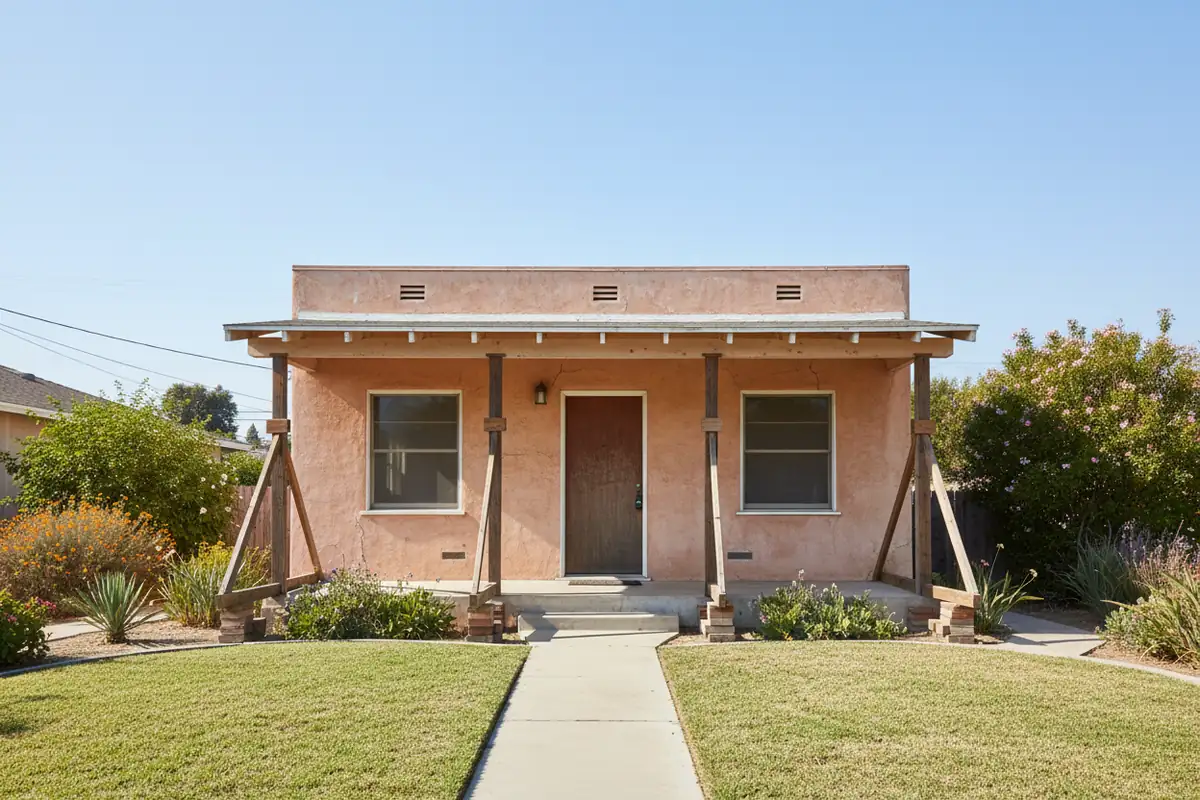
A red tag on a California house is a notice posted by a local building or code enforcement official stating that the structure is unsafe to occupy or use. It stays in place until the agency that posted it decides the conditions are corrected. The owner's main paths are correcting the conditions, pursuing permits or legalization, or selling the property in its present condition.
On this page
Key Takeaways
A red tag is also called an unsafe-structure posting or placard. A local building official, a code enforcement officer or a fire official puts it on a structure after finding conditions that make the building unsafe to occupy or use. The building official is the person in a city or county building department who enforces building codes. The code enforcement officer enforces local property and housing rules.
- It is not a court order, but it has legal weight. Occupying a posted structure can expose the owner and any occupants to further enforcement action.
- The posting agency controls it. The office that issued the tag is also the office that removes it. That office may be a city building department, a county code enforcement office or a fire marshal.
- There are three broad paths. Correct and keep, correct then sell, or sell in present condition with disclosure. Each is compared in detail under Options to Compare.
- No path is right for every owner. Each one asks for different amounts of money, time and effort.
Placards usually come in three colors. A red tag generally means the building has been found unsafe for occupancy. A yellow tag generally means restricted or limited use. A green tag generally means the building was inspected and no apparent hazard was found. A red tag is also different from a notice of violation, which is a written notice that violations exist and must be corrected. It differs too from a citation, which usually carries a penalty, and from an abatement order, which directs that the condition be removed or corrected, sometimes by the agency itself. A property can receive more than one of these documents. Each one states its own requirements.
When This Option Fits
This page is written for an owner deciding what to do about a property that has been posted as unsafe. That owner may be in one of several situations:
- After a damaging event. The house was red-tagged after a fire, a flood, an earthquake or another event that damaged the structure.
- After an inspection. An inspection turned up unpermitted work, structural deficiencies or habitability violations. A habitability violation is a condition that makes a dwelling unfit to live in.
- As an heir or new owner. The owner found the red tag only when taking title.
- As a landlord. A rental property has been posted and the tenants have had to leave.
- As an investor. The owner bought a red-tagged property, or is considering buying one, and needs to understand what clearing it involves.
In each of these situations, the property's condition and the agency's file shape the answer. A landlord with displaced tenants faces different questions from an heir who has never lived in the house. Both still start with the same posting and the same office.
Some situations call for a different kind of help. When a co-owner, a lender or the agency is in active dispute with the owner, or when enforcement has reached a court proceeding, the matter is a contested one for an attorney. This page explains the owner's options and how each one works. It does not give legal, tax or construction advice.
How It Works, Step by Step
The process generally runs in the order below. The posting itself and the agency's file decide the details for a particular property.
- Read the posting closely. The useful details are the agency's name, the violations listed, any deadline stated on the notice, and the contact name or number. The tag is physically posted on the structure. It is generally treated as a public record, and it usually names the conditions found and the office responsible.
- Contact the posting agency. The building department or code enforcement office can provide the full written record of what the inspector found and what correction requires. That record is often more detailed than the placard.
- Learn the correction path. The agency may require the work to be done by a contractor, permits for unpermitted work, or an assessment by a structural engineer before repairs begin. For an unpermitted addition or conversion, this may mean an after-the-fact permit, which is a permit applied for once the work already exists.
- Raise any disagreement through the agency's process. An owner who believes the posting was made in error, or that the conditions were mischaracterized, can generally ask for an appeal or a hearing. The notice or the agency's office explains how to request one.
- Complete the work and get it inspected. The building official decides when the conditions are corrected and signs off. The tag is then removed. The owner and the contractor do not remove the tag.
- Understand what follows if the conditions stay uncorrected. The agency may move to abatement, meaning it arranges the work itself and bills the owner. Under many local procedures, unpaid abatement costs can be recorded as a lien. A lien is a claim against the property that secures a debt. A recorded lien follows the property, not only the owner, and a buyer takes title subject to any recorded lien. The notice and the agency's office state what applies in a particular place.
Costs, Timing and Trade-offs
What correction costs depends on what the violations are. Structural repairs, electrical work and plumbing work vary widely in scope. Permit fees vary by jurisdiction. Legalizing unpermitted work can involve plan-check fees, which pay for the agency's review of drawings, as well as inspection fees and the cost of bringing the work up to current code. Each local building department publishes its own fee schedule. A contractor or an engineer who has seen the property can estimate the repair work. When the tag followed a fire, a flood or another insured event, the insurance documents listed under What to Have Ready are part of the picture of how repairs might be paid for.
Timing has several moving parts:
- the agency's inspection schedule
- how complex the corrections are
- whether permits and plan review are required
Only the posting agency can describe realistic timing for its own jurisdiction. This page does not estimate it.
Abatement by the agency generally costs more than correction the owner arranges, because the agency uses its own contractors and adds administrative costs. The owner also has less control over who does the work and how, and the owner's choices narrow over time.
Selling the property in its present condition moves the correction work to the buyer. The owner still makes full disclosure, and the price reflects the condition. A buyer who takes on the repairs prices that work and its risk into the offer. For that reason, the price of an as-is sale is often lower than the price of the same house after correction on the open market.
Comparing written offers and estimated net proceeds shows how the paths measure up in money. Net proceeds are the price less any liens, loan payoffs, commissions, repair and carrying costs, and closing costs. That comparison does not say which path fits. It puts the paths side by side in the same terms.
Options to Compare
Each of the three paths trades money, time and effort differently.
| Option | What it involves | Main trade-off |
|---|---|---|
| Correct and keep | Repairs and permits, re-inspection, tag removed | Restores use, but the owner carries the cost, the time and the coordination with the building department |
| Correct, then sell | The same correction work, then a sale of the cleared property | A broader pool of buyers and often a higher price, but the correction costs come first |
| Sell in present condition | Disclose the tag and violations, and the buyer accepts the condition | Less preparation for the owner, but the price reflects the work and risk the buyer takes on |
Correcting and keeping fits an owner who wants the property back in use and can fund and oversee the work. Clearing the tag restores occupancy. On a rental, it can also allow tenants to return.
Correcting, then selling puts a cleared property on the market. A buyer using a mortgage loan can more readily consider a house that is no longer posted. The owner, however, pays for the correction work before any sale proceeds arrive.
Selling in its present condition means a buyer who accepts the property as it is takes on the correction work. That buyer may be someone found through a real estate agent or a buyer who pays cash directly. A direct offer is often lower than what the house might bring on the open market, because the buyer takes on the repairs, the risk and the cost of reselling. In exchange, the seller gets less preparation, fewer showings and less dependence on a buyer's loan approval. "As-is" describes the condition the buyer accepts. It does not change the seller's duties.
Disclosure applies whichever way the property is sold, unless an exception applies. Civil Code section 1102 provides that, except as provided in Section 1102.2, the disclosure article it begins applies to any transfer of single-family residential property by sale, exchange, real property sales contract, lease with an option to purchase, any other option to purchase, or ground lease coupled with improvements. The same section makes any waiver of those requirements void as against public policy. A red tag and the violations it lists are facts about the property's condition. A real estate agent or an attorney can say which disclosure forms a particular sale requires. Recorded liens stay with the property in every type of sale. No company is named or ranked here. The point is to compare the paths themselves.
What to Have Ready
The same set of papers comes up whether the owner calls the agency, gets a contractor's estimate or talks with an attorney:
- The red tag. The placard itself or a clear photograph of it, including the agency name, the violation descriptions and any case or reference number.
- Mailed notices. Any written notice of violation, citation or abatement order the agency has sent.
- Permit history. The record of permits issued for the property, available from the local building department and often online.
- Title documents. These show who the owner of record is. The owner of record is the person or entity named on the recorded deed. This matters because the owner of record, or someone authorized to act for that owner, is generally the person who applies for permits and signs correction agreements.
- Prior reports. Earlier inspection reports, contractor estimates and engineering assessments.
- Insurance documents. These apply if the tag followed a fire, a flood or another insured event.
- Agency contact. The name and contact details of the inspector or case officer assigned to the property.
Many of these papers sit in different places. Gathering them is often the slowest part of getting started, especially for an heir handling a relative's property.
Local Context: California Cities and Counties
California has hundreds of cities and counties, and each one has its own building department or code enforcement office. Each also has its own procedures for posting, appealing and clearing unsafe-structure notices. The statewide framework comes from the California Health and Safety Code provisions on substandard buildings, which set out what makes a building substandard and the authority to act on it. Local ordinances add each jurisdiction's own procedures on top of that framework. Background on how California treats building code violations explains that statewide layer in more depth.
The same kind of posting can be handled differently in Los Angeles, San Francisco, San Diego, Sacramento, Oakland, San Jose, Fresno or Riverside. Appeal steps, inspection scheduling and fees are set locally, and this page does not state any of them for any city. More on San Diego appears in the guide to San Diego code violation help. For a property in an unincorporated area, which is land outside any city's limits, the county's building or code enforcement department is the posting authority, not a city.
For any of these places, the notice on the door and the posting agency's own website are the sources for local procedures, deadlines and appeal rights. A common next step is obtaining two records from that agency: its written list of what the inspector found, and the property's permit history. The central question for the agency is which conditions must be corrected, and under which permits, before the tag can come down.
Ready to talk through your options?
Share the details of your notice. You choose whether contractors or a sale consultant may contact you.
Get help with my propertyFrequently asked questions
What does a red tag on a house mean?
A red tag means a local building official, code enforcement officer or fire official has posted the structure as unsafe to occupy or use, based on conditions found during an inspection. The placard stays in place until the agency that posted it decides those conditions have been corrected.
Can you fix a red-tagged house?
Yes. Correction is one of the owner's main options, following the steps in How It Works, Step by Step. The building official, not the owner, decides when the tag can be removed.
What does a red tag mean in construction?
On a construction project, a red tag usually means an inspector has stopped the work. The work may have been done without a permit, outside the approved permit's scope, or not to code. That differs from an unsafe-structure posting after a disaster, but both are resolved through the local building department.
What does it mean if a house is red-tagged in California?
In California, a red-tagged house has been posted as unsafe to occupy under state and local authority. Occupying it can lead to further enforcement. The posting agency is the first source for what is required.
Can a red-tagged house be sold in California?
Yes, in its present condition, with the tag and the violations disclosed. The disclosure duties covered in Options to Compare generally apply however the sale is structured, though the article's requirements do not apply to certain transfers, such as some court-ordered, foreclosure, fiduciary and co-owner transfers, and recorded liens remain.
Does a red tag mean I have to move out immediately?
Generally, a red tag means the building official has found the structure unsafe to occupy, and staying in it after posting can bring further enforcement. The notice itself states what is required. Some postings allow limited entry to retrieve belongings, and the posting agency can explain the conditions for that particular property.
How do I get a red tag removed from my house in California?
Removal comes after the posting agency is satisfied that the cited conditions are corrected and the building official signs off. Only the agency authorizes removal.
What happens if I ignore a red tag on my property?
Ignoring a red tag generally leads to escalating enforcement, such as citations or abatement, with unpaid costs possibly recorded as a lien that follows the property into any sale.
What is the difference between a red tag and a code enforcement notice?
A notice of violation is a written notice that violations exist and must be corrected. A red tag is a placard posted on the structure declaring it unsafe to occupy. An abatement order directs that the condition be removed or corrected. A property can receive all three, and each states its own requirements.