An owner holding one of these notices is looking at a government document that names a building they are responsible for, lists conditions in official language, and sets a deadline. The questions it raises are practical ones: what the agency actually found, what the law expects next, whether the property can still be sold or financed, and what happens if the repairs cannot be done in time. This guide walks through how California's State Housing Law treats a substandard building and what a notice to repair asks of the owner, so the choices between correcting the violations, getting professional help and selling the property as it is become easier to see clearly.
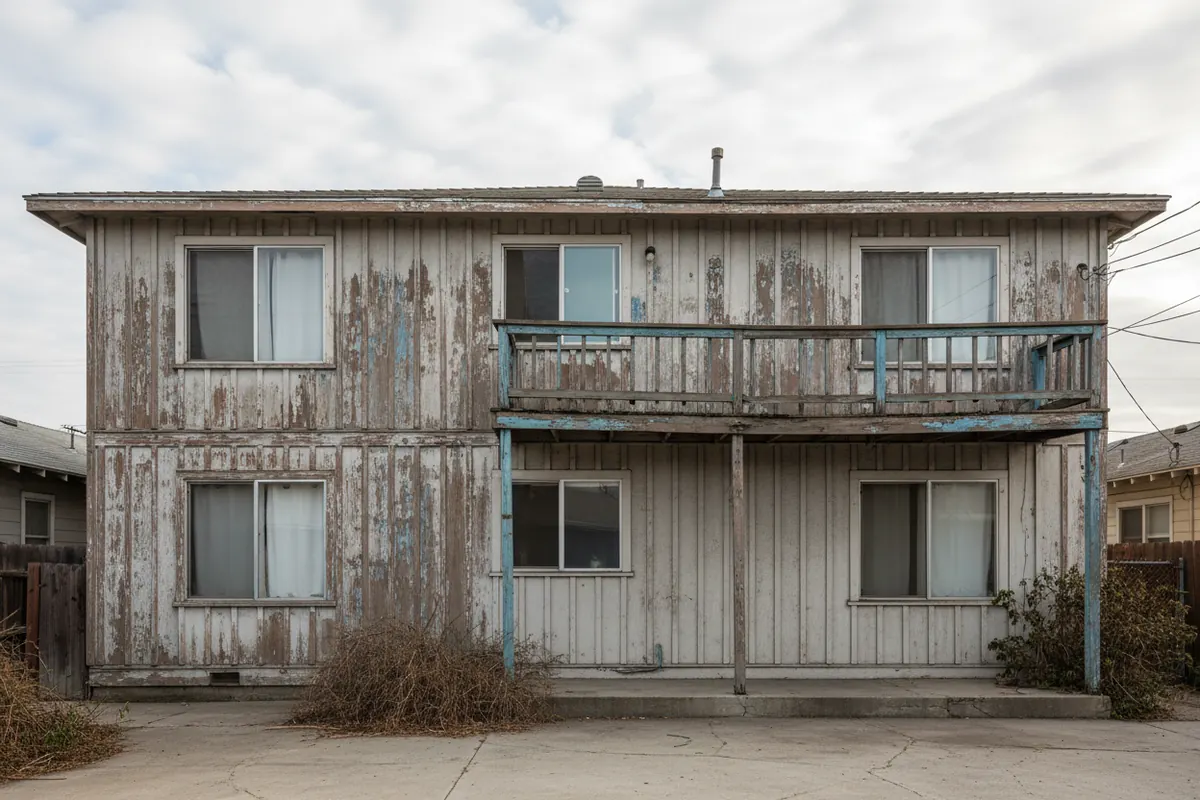
A substandard building notice in California tells an owner that a local enforcement agency found conditions in a building that endanger the occupants, neighbors or the public. It asks the owner to correct those conditions, generally after 30 days' notice, by repair or, in some cases, demolition. A shorter period applies when the agency finds an immediate threat.
On this page
What a Substandard Building Notice Means for Owners
Health and Safety Code section 17920.3 is the starting point. It defines a substandard building as any building, or part of one, where certain listed conditions exist "to an extent that endangers the life, limb, health, property, safety, or welfare of the occupants of the building, nearby residents, or the public." In plain words, a building is substandard when its condition is unsafe enough to put people at risk, regardless of zoning designation or approved uses.
The statute's list is long. It includes:
- inadequate sanitation, such as missing or improper toilets, sinks or bathing fixtures, lack of hot and cold running water, lack of adequate heating, dampness, infestation and visible mold growth as determined by a health officer or a code enforcement officer;
- structural hazards, such as deteriorated foundations, sagging floors or roofs, and leaning chimneys;
- any nuisance;
- wiring, plumbing and mechanical equipment, each with exceptions for systems that met the law when installed and remain safe and working;
- faulty weather protection, such as crumbling plaster or broken windows;
- fire hazards, materials not allowed by the code, accumulated debris or junk that creates a hazard, inadequate exits, missing fire-resistive construction, rooms used for living or sleeping that were not designed for it, and inadequate structural resistance to horizontal forces.
That list continues in the statute itself, which uses "shall include, but not be limited to" for several categories.
Health and Safety Code section 17980 supplies the enforcement step. When a building is built, altered or maintained in violation of the State Housing Law, or a nuisance exists on the lot, the enforcement agency acts "after 30 days' notice to abate," or a shorter period "if deemed necessary by the enforcement agency to prevent or remedy an immediate threat." The exact deadline is the one printed on the notice. Once the agency starts an action or proceeding, Health and Safety Code section 17985 requires it to record a notice of the pendency of that action with the county recorder, which places it in the public record for the property. A broader look at building code violations for owners covers how these fit with other code problems.
Who a Substandard Building Notice Affects
The owner of the building carries the duty to respond. Health and Safety Code section 17980 speaks of "the owner" throughout: the owner chooses between repairing and demolishing, and the agency may charge the owner for its postage or mileage cost in sending or posting the required notices.
Tenants are affected too. Under section 17980, tenants in a residential building must receive copies of a notice of violation that makes the building substandard, of any inspection order declaring the dwelling in violation, of the agency's decision to repair or demolish, and of a building or demolition permit issued after an abatement order. The agency that issued the notice delivers those copies to each affected unit.
An heir, a buyer or an investor who takes over a property after an action has begun should know that the recorded notice of pendency stays in the county record. Section 17985 says the agency records a notice of final disposition "immediately following final resolution of the action or proceeding," which is what marks the matter as resolved in that record. One narrow statutory rule applies to buyers of foreclosed homes: if a person bought a residential property that had been foreclosed on or after January 1, 2008, and is diligently abating the violation, the agency generally may not begin an action until at least 60 days after the person takes title, unless it decides a shorter period is needed to address an immediate threat.
Where title is held by more than one person, the facts of how title is held matter. A disagreement among co-owners about what to do is a contested matter handled by an attorney.
Rules, Disclosures, and Fine Print
Every notice to correct violations carries one item owners sometimes skim past. Health and Safety Code section 17980 requires all such notices to tell the owner that, under the Revenue and Taxation Code, a tax deduction may not be allowed for interest, taxes, depreciation or amortization paid or incurred in the taxable year. Whether that affects a particular owner is a question for a CPA, an enrolled agent or a tax attorney.
When violations are so extensive that the health and safety of residents or the public is substantially endangered, Health and Safety Code section 17980.6 lets the agency issue an order or notice to repair or abate. That order is delivered either by posting it in a conspicuous place on the property and mailing it by first-class mail to each affected unit, or by posting it on the property and on each affected unit. Its contents include, but are not limited to, the agency's name, address and telephone number; the date, time and location of any public hearing or proceeding on the order; and information that a landlord cannot retaliate against a tenant under California law. The hearing details printed on the notice are the ones that govern that case. Reading code enforcement notices line by line helps an owner find them.
A sale brings in a separate set of rules. Civil Code section 1102 applies the seller disclosure article to transfers of single-family residential property by sale, exchange, real property sales contract, lease with an option to purchase, other options to purchase and certain ground leases. The seller's disclosure form under that article is called the Transfer Disclosure Statement: the written statement a seller gives a buyer about the property's condition. Section 1102(c) says any waiver of the article's requirements "is void as against public policy," so a cash buyer or an as-is purchase does not change the seller's duties.
The article does not apply to every transfer. Civil Code section 1102.2 exempts certain transfers, including court-ordered sales, foreclosure-related transfers, transfers by a fiduciary administering a trust or estate (with an exception for some revocable-trust trustees), "sales or transfers from one coowner to one or more other coowners," transfers to a spouse or "to a person or persons in the line of consanguinity of one or more of the transferors," and transfers "to or from any governmental entity." The list continues in the statute. An attorney can say how these rules apply to a particular sale.
Options and Trade-offs
Section 17980 gives the owner a choice at the core of the process: "The owner shall have the choice of repairing or demolishing." If the owner chooses repair, the agency requires the building to be brought into compliance on "a reasonable and feasible schedule for expeditious repair." In deciding between vacating a building and requiring repair, the agency gives preference to repair whenever it is economically feasible without repairing more than 75 percent of the dwelling, as the agency determines, and considers local housing needs.
Correct the violations. Repair under permits, followed by the agency's inspection, is the path the statute favors. The cost depends on the conditions cited, and a contractor or an inspector can describe the work involved. Correction does not promise that the agency will close the case on any particular schedule; the agency decides when the matter is resolved.
Legalize unpermitted work. Where the cited conditions involve construction done without permits, an owner may ask the local building department about an after-the-fact permit. That department decides whether the work can be legalized or has to come out, and no permit is assured.
Demolish. Demolition is the owner's other statutory choice, and for some buildings it may be the more practical one. Local permits apply to it as well.
Sell the property in its present condition. A house with a substandard building notice can be sold as it is, but the sale does not end the notice, the recorded record or the seller's disclosure duties described above. A buyer who pays cash and takes the property as it is often offers less than an open-market price, because that buyer takes on the repairs, the enforcement risk and the cost of reselling. In exchange, the seller usually faces less preparation, fewer showings and less dependence on a buyer's loan. A listing with a real estate agent may reach more buyers but can require more work up front. Comparing written offers and estimated net proceeds, meaning the price less commissions, repairs, carrying costs, loan payoffs and closing costs, is how an owner tells which path fits.
Take no action. Under section 17980, the agency may require vacation and demolition, or may itself vacate, repair or demolish the building, or bring another action, if the repair work is not done in the period the notice requires, the owner does not make a timely choice of repair or demolition, or the owner picks an option that cannot be completed in a reasonable time.
A dispute with a co-owner, a lender or the agency itself is a contested matter that an attorney handles.
Mistakes to Avoid
Overlooking the hearing information is an easy error. A notice issued under section 17980.6 includes the date, time and location of any public hearing or proceeding, and an owner who does not read that part may miss the chance to be heard on the agency's findings. An attorney can explain what a missed hearing means in a particular case.
Repairing without permits can create a fresh problem. Work done without the permits the local department requires may itself be cited, and a repair the building department has not inspected may not resolve the original condition.
Assuming a sale clears the record is another. The notice of pendency recorded under section 17985 stays in the county record until the agency records a notice of final disposition, and a buyer's title search can find it.
Letting the deadline pass without choosing a path matters under section 17980: a failure to make a timely choice of repair or demolition is one of the events that lets the agency act on its own.
Reading the notice as a demolition order is a common misunderstanding. A notice to repair or abate is not automatically a demolition order; the statute leaves the choice between repairing and demolishing to the owner unless the conditions in section 17980 for agency action are met. When a building has been posted as unsafe to occupy, the issues overlap with a red-tagged house, which raises occupancy questions of its own.
What to Do Next
The notice itself is the first document that matters. It names the agency that issued it, the conditions cited, the action required and the deadline, and, for an order under section 17980.6, the agency's contact information and any hearing date. An owner thinking through the choices in this guide may also look over code violation help for Southern California properties.
The county recorder's records show whether a notice of pendency has been recorded against the property, and a title report shows the same thing to a buyer or a lender. The agency's file on the case may show which inspections were done and what it plans next.
California Code Violation Property Solutions offers a request form for an owner who wants to talk through correction, legalization or a sale; a reader can request a code violation options consultation through it.
A practical next step is finding the notice, noting its deadline and any hearing date, and checking the county recorder's index for a recorded notice of pendency on the parcel.
Ready to talk through your options?
Share the details of your notice. You choose whether contractors or a sale consultant may contact you.
Get help with my propertyFrequently asked questions
What is a substandard building under California law?
A substandard building is one where conditions listed in Health and Safety Code section 17920.3 exist to an extent that endangers occupants, nearby residents or the public. The list includes inadequate sanitation, structural hazards, nuisances, faulty weather protection, fire hazards and inadequate exits, among others, as described above.
What is the most common building code violation?
No statistic on this appears in the statute. The categories section 17920.3 names, including inadequate sanitation, structural deterioration, wiring, plumbing, weather protection and rooms used for living that were not designed for it, show the kinds of conditions a notice can cite.
What happens if I ignore a substandard building notice in California?
Under Health and Safety Code section 17980, if the repairs are not done in the required period or the owner does not make a timely choice of repair or demolition, the agency may require vacation and demolition, or may itself vacate, repair or demolish the building, or bring another action.
Can I sell a property that has a substandard building notice in California?
Yes, it can be sold in its present condition. The sale does not end the notice or a recorded notice of pendency, and the seller disclosure rules in Civil Code section 1102 still apply unless a section 1102.2 exemption covers the transfer. An as-is buyer's offer often reflects the repair cost and risk that buyer takes on.
Do I have the right to appeal a substandard building notice in California?
An order issued under Health and Safety Code section 17980.6 must state the date, time and location of any public hearing or proceeding on it. The notice itself is where an owner finds that information, and an attorney can explain the appeal options in a specific case.
What is the California Building Standards Code?
It is the body of building standards that the State Housing Law refers to. Health and Safety Code section 17980 lists violations of "the building standards published in the California Building Standards Code" among the grounds for a notice to abate.
Does a substandard building notice affect my ability to sell or refinance?
It can. Once an agency starts an action, Health and Safety Code section 17985 has it record a notice of pendency with the county recorder, which a buyer's or lender's title search can find. A title company or an attorney can say how it bears on a particular sale or loan.